The most talked-about skin booster may not be the right choice for your skin. If you’re wondering how to choose the right skin booster for me, start with the concern you want to address, not a product name or social media trend. Products grouped under the same label can have different purposes, and a treatment designed to improve skin quality won’t necessarily add facial volume or suit everyone.
It’s understandable to want a clear answer, especially when claims about glow, firmness and rejuvenation can sound similar. The right option depends on your skin, priorities and realistic expectations, which is why individual assessment matters. This guide explains the concerns skin boosters may help with, what to compare when considering options, and what to discuss about suitability, possible risks and treatment planning. At Arden Clinic, treatment plans are tailored following consultation and assessment, helping connect your goals with an appropriate approach rather than a passing trend.
Key Takeaways
- To work out how to choose the right skin booster for me, begin by defining the skin concern and result you hope to address.
- Compare options by their intended purpose and the formulation details explained during your assessment, not by the “skin booster” label alone.
- Prepare to discuss your relevant history, suitability, possible limitations, risks and aftercare with your practitioner.
- An individual assessment can help shape realistic aims and a treatment plan suited to your needs.
How to choose the right skin booster for me: start with your skin concern
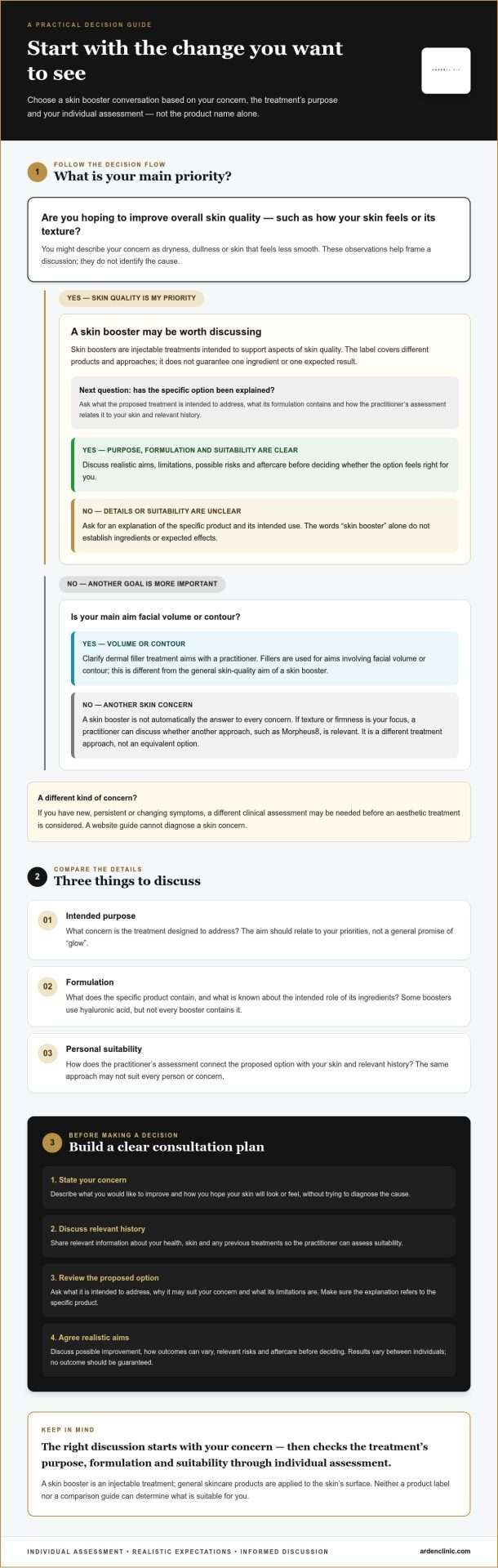
Start with the change you hope to see, not the name of a product. If you’re asking, “how to choose the right skin booster for me?”, first consider whether your goal is to improve overall skin quality. “Skin booster” is an umbrella term for injectable treatments intended to support aspects of skin quality; the products and approaches grouped under it can differ. It isn’t a standardised description of one ingredient or one expected result.
In brief: a skin booster is an injectable aesthetic treatment intended to improve skin quality, whereas a general skincare product is applied to the skin’s surface. Some boosters use hyaluronic acid, a substance found in the body; the Hyaluronic Acid overview explains its properties and uses. That doesn’t mean every booster contains it, so the proposed formulation needs to be discussed individually.
Name the change you hope to see
Describe your concern in everyday terms: perhaps your skin feels dry, looks dull, or seems less smooth than before. These observations help frame a consultation, but they don’t identify the cause. A website guide can’t diagnose a skin concern. New, persistent or changing symptoms may need a different clinical assessment before an aesthetic treatment is considered. A booster may not be the appropriate route for every concern.
Skin booster or dermal filler: why the aim matters
The intended aim is different. A skin booster is generally considered for skin quality, while dermal fillers are used for aims involving facial volume or contour. Neither label alone determines suitability, and the right approach depends on individual assessment. If your priority is shape or volume rather than skin feel or texture, clarify the dermal filler treatment aims with a practitioner. Being clear about the change you want helps guide a more relevant discussion about options and realistic expectations.
Compare skin booster options by purpose, formulation and suitability
The words “skin booster” don’t tell you exactly what a product contains or what effect it’s intended to have. Compare the proposed option using details that can be explained and assessed, rather than assuming products with the same label are interchangeable.
| What you want to compare | What to discuss | Why it matters |
|---|---|---|
| Intended purpose | What concern is the treatment designed to address? | The aim should relate to your priorities, not a general promise of “glow”. |
| Formulation | What are the product’s ingredients, and what is known about their intended role? | The name “skin booster” alone doesn’t establish ingredients or expected effects. |
| Personal suitability | How does the practitioner’s assessment relate the proposed option to your skin and relevant history? | The same approach may not suit every person or concern. |
This is a discussion framework, not a ranking. To work out how to choose the right skin booster for me, ask for the specific product details and intended use, then consider them alongside your individual assessment. Claims about ingredients, how a formulation works and supporting evidence should be checked with the relevant clinician before publication or relied on in treatment decisions.
Consider whether another approach is more relevant
A skin booster isn’t automatically the answer to every concern about skin appearance. If texture or firmness is your main focus, a practitioner can discuss whether another approach, such as Morpheus8 treatment, is relevant. It has a different treatment approach, so it shouldn’t be treated as equivalent to a skin booster.
Comparison takeaway: the appropriate option depends on verified product details, your concern and personal assessment. If you’d like to discuss your goals in an individual consultation, you can contact Arden Clinic.
Use this consultation checklist to judge whether a skin booster suits you
A useful assessment should connect your concern with a clear, realistic treatment plan. Individual assessment helps align treatment choice with your personal concerns and expectations. A recommendation should follow a discussion of your needs and suitability, not pressure to choose a particular product.
- State your concern. Describe what you’d like to improve and how you hope your skin will look or feel. Be as specific as you can without trying to diagnose the cause.
- Discuss relevant history. Share information about your health, skin and any relevant previous treatments. This gives the practitioner context when assessing whether a treatment may be suitable.
- Review the proposed option. Ask what the treatment is intended to address, why it may suit your concern and what its limitations are. Make sure the explanation relates to the specific product being proposed.
- Agree realistic aims. Discuss what improvement may be possible, how outcomes can vary and what aftercare or risks are relevant before deciding whether to proceed.
Questions to take into an assessment
Use these prompts to make the conversation practical: “What is this treatment intended to address, and why might it suit my concern?” “What aftercare should I expect?” “What possible reactions or risks should I understand?” Ask when you should seek professional advice if you have a concern after treatment. The practitioner should explain these points in relation to the proposed option and your individual circumstances.
Set realistic expectations before deciding
Results vary between individuals, and no outcome should be guaranteed. A treatment may not address every concern or deliver the change you have in mind. Take time to consider the explanation, and raise any unanswered questions about suitability, limitations or aftercare. You should feel informed enough to make a considered decision, rather than rushed into selecting a named product.
At Arden Clinic, recommendations are tailored following appropriate consultation and assessment. If you’re considering a skin booster, an individual discussion can help clarify whether the proposed approach fits your concerns and expectations.
Plan your next step with an individual skin-booster assessment
A considered decision follows a clear path: define the concern you want to address, compare treatment aims, ask informed questions and then consider whether an assessment is appropriate. If you’re working out how to choose the right skin booster for me, focus on whether the proposed approach fits your priorities, rather than feeling you need to select a product before speaking with a practitioner.
What happens when treatment planning is individualised
At Arden Clinic, consultation and assessment help establish whether a proposed approach is relevant to your concerns and expectations. The practitioner can discuss the option’s intended purpose and explain its limitations, so treatment selection is based on your individual needs. Arden Clinic was founded in 2011, and its approach centres on tailored treatment planning following appropriate assessment.
An assessment is also a chance to clarify what you hope to change and whether a skin booster is a suitable consideration. If another concern needs a different kind of clinical assessment, that should be discussed rather than assuming one treatment addresses every skin issue.
Decide without pressure
Take time to understand the explanation before making a decision. Ask about suitability, realistic outcomes, possible limitations, relevant risks and aftercare. If anything is unclear, raise it; you can consider the information and return to the decision when you feel ready. Treatment is not the right choice for everyone, and results can vary between individuals.
Arden Clinic welcomes clients in Bradford and Leeds who want to discuss their skin concerns through an individual assessment. A conversation can help you understand the options and decide on an appropriate next step, without committing to a treatment before your questions have been answered.
Take your next step with confidence
A useful consultation is a chance to discuss what matters to you, not a commitment to a treatment. Rather than arriving set on a product, bring your questions and be open to a recommendation shaped by professional assessment. If you’re asking, “how to choose the right skin booster for me?”, focus on whether the proposed approach makes sense for your concern and expectations.
Arden Clinic is a multi-award-winning clinic, with individualised consultation and treatment planning at the centre of its approach. You can take time to understand the advice, consider your options and decide whether you feel comfortable proceeding. The aim is a considered choice, with no assumption that one treatment suits everyone.
Bring your questions, take the time you need and move forward when you feel informed.
Frequently Asked Questions
Are skin boosters suitable for every skin type?
No, suitability can’t be determined from skin type alone. It also depends on your individual concerns, relevant skin history and the specific treatment being considered. For example, mention any previous reactions or treatments during an assessment, even if they seem unrelated. A practitioner can consider this information alongside your expectations and advise whether the option is appropriate, without diagnosing a skin condition from appearance alone.
How long do skin booster results last?
There isn’t one duration that applies to every skin booster treatment. Products, treatment plans and individual responses differ, so a general timeframe could be misleading. During assessment, ask what outcome is realistic for the particular option being discussed and whether maintenance might be considered. The practitioner should explain any relevant evidence and limitations clearly, rather than promising that results will last for a set period.
How many skin booster treatments might I need?
There’s no single course or fixed number of sessions that suits everyone. The practitioner should explain any proposed schedule in relation to the specific treatment, your concerns and the aims you’ve discussed. Ask why that plan is being suggested, what each session is intended to achieve and whether it may be reviewed as treatment progresses. You should understand the rationale before deciding whether to proceed.
Can I combine a skin booster with another skin treatment?
Possibly, but combining treatments is an individual planning decision, not a recommendation that applies to everyone. Tell the practitioner about relevant treatments you’ve had or are considering, including when they took place. They can assess your concerns, history and the options under discussion, then explain whether a combined plan or separate timing is appropriate. Don’t assume two treatments are suitable together based on general advice online.
What should I do if I am unsure whether my concern needs a skin booster?
Describe what you’ve noticed and seek professional assessment rather than trying to diagnose it or choosing a treatment by name. If you’re asking “how to choose the right skin booster for me?”, a practitioner can discuss whether a booster may be relevant or whether another approach should be considered. This discussion can inform your next step, but it can’t guarantee a particular treatment recommendation or outcome.