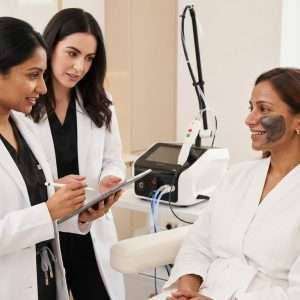
The best SPF to use after laser treatments isn’t simply the product with the biggest number on the bottle. A high-factor sunscreen may be appropriate, but when you can apply it and which formula your skin will tolerate depend on the treatment and how your skin is recovering.
If you’re unsure whether to choose mineral or chemical sunscreen, how to assess UVA protection, or whether a product could irritate tender skin, that uncertainty is understandable. Laser aftercare isn’t one-size-fits-all: recovery after light, moderate or deep CO₂ resurfacing can differ substantially, and your treating practitioner’s instructions should take priority over general guidance.
This guide explains how to compare SPF and UVA labels, what to consider when selecting a fragrance-free or mineral formula, and how to protect your skin with shade and clothing as well as sunscreen. It also clarifies why there’s no universal point for restarting SPF after treatment. Arden Clinic’s assessment-led approach takes account of the treatment performed and your individual skin response.
Key Takeaways
- The best SPF to use after laser treatments depends on the procedure, its intensity and how your skin is recovering.
- Compare both the SPF number and the UVA protection marking; they indicate different aspects of sun protection.
- Follow your clinic’s aftercare instructions before restarting sunscreen, particularly if your skin is still compromised.
- If you’re uncertain about timing or formula, personalised guidance in Bradford or Leeds can help you plan sun protection around your recovery.
Why the best SPF after laser treatment depends on the procedure
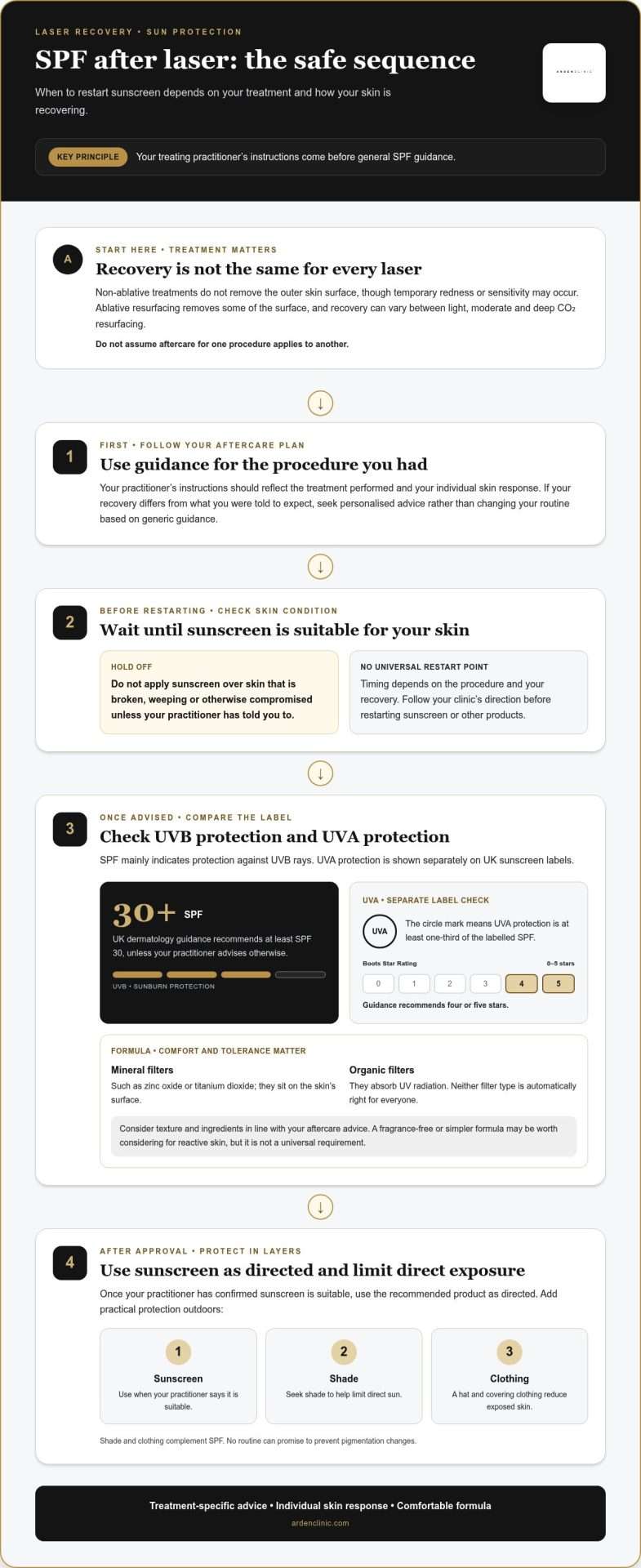
SPF, or Sun Protection Factor, indicates how well a sunscreen protects against UVB rays, which can cause sunburn. After laser treatment, sun protection means limiting exposure and using sunscreen when your practitioner says it is suitable. The best SPF to use after laser treatments depends on what was treated, the treatment’s intensity and how your skin responds, not just the number on the bottle.
A review of sunscreen outcomes across ablative, non-ablative and intense pulsed light (IPL) treatments discusses its role in supporting treatment outcomes and reducing complications. It does not make every procedure or recovery identical. Procedure-specific aftercare matters because laser treatments affect the skin in different ways, so product timing and skin tolerance need to be considered in light of the treatment performed.
How laser treatment can affect the skin’s response to sunlight
Some procedures temporarily change the skin’s surface or leave it feeling more sensitive. This can make sun exposure and product choice relevant during recovery, but it does not mean every laser treatment leaves skin open or equally vulnerable. For example, the effects of a picosecond laser treatment for pigmentation depend on the procedure and individual response; Arden Clinic’s PICO pigmentation treatment in Bradford is one example of a laser service requiring tailored aftercare.
Why treatment intensity changes the aftercare conversation
Non-ablative treatments work without removing the outer skin surface, although temporary redness or sensitivity may still occur. Ablative resurfacing removes some of that surface to varying degrees. Light CO₂ resurfacing, moderate resurfacing and deep resurfacing are not interchangeable: recovery can vary substantially with treatment intensity. General information about laser resurfacing describes the approach, but your own aftercare must reflect the procedure you received.
In practical terms, don’t assume advice for a non-ablative treatment applies after resurfacing, or that all resurfacing requires the same routine. Your practitioner’s instructions should guide when sunscreen and other products are suitable. If your skin’s response differs from what you were told to expect, seek personalised advice rather than changing your aftercare based on a generic recommendation.
How to compare SPF products after laser treatment
Once your practitioner has confirmed sunscreen is suitable, compare the label and how the formula feels on your skin. The best SPF to use after laser treatments needs to provide appropriate UVB and UVA protection whilst fitting your recovery instructions and skin tolerance.
What to check on the sunscreen label
SPF mainly describes protection against UVB rays. UVA protection is shown separately on UK sunscreen labels. Look for the UVA-in-a-circle mark or a Boots Star Rating; the circle indicates UVA protection of at least one-third of the labelled SPF, while the star scale runs from zero to five. UK dermatology guidance recommends at least SPF 30 and a UVA rating of four or five stars.
| What to compare | What to look for |
|---|---|
| SPF | At least SPF 30 as a general UK recommendation, unless your practitioner advises otherwise. |
| UVA protection | A UVA circle or a high Boots Star Rating, ideally four or five stars. |
| Filter type | Mineral filters, such as zinc oxide or titanium dioxide, and organic filters protect in different ways. Neither type is automatically right for everyone. |
| Skin tolerance | Consider whether the texture, ingredients and application feel comfortable, in line with your aftercare advice. |
Mineral filters sit on the skin’s surface, while organic filters absorb UV radiation. Some people prefer one texture over another, but recent treatment, sensitivity and practitioner instructions matter more than a blanket rule. A fragrance-free or simpler formula may be worth considering if your skin is reactive, though it isn’t a universal requirement. Don’t test or apply a product to treated skin until your practitioner says it’s suitable.
Choosing a formula your skin can tolerate
Think about practical use too: a formula you can apply comfortably is more likely to fit your routine. If you’re unsure how to balance label claims with your recovery advice, you can discuss your treatment and aftercare with Arden Clinic.
When and how to use SPF during laser recovery
Use a simple sequence, but let your treating clinic set the timing. The best SPF to use after laser treatments is only useful once your practitioner has confirmed that sunscreen is suitable for your skin at its current stage of recovery.
- Follow your clinic’s instructions. Use the aftercare plan for the procedure you had, rather than advice intended for a different laser treatment.
- Wait for direction before restarting products. Don’t apply sunscreen over skin that is broken, weeping or otherwise compromised unless your practitioner has told you to do so.
- Once advised to resume, maintain sun protection. Use the recommended sunscreen as directed, and continue to limit direct exposure.
Shade and clothing add useful layers of protection. A hat and covering clothing can reduce the amount of skin exposed outdoors, while seeking shade helps limit direct sun. These measures complement SPF, but no routine can promise to prevent pigmentation changes.
Aftercare after pigmentation and tattoo laser treatments
Aftercare depends on the treated concern, the laser procedure and your skin’s response. Pigmentation treatments are not all the same, so instructions for one concern may not suit another. Arden Clinic’s PICO pigmentation treatment and PICO tattoo removal are distinct treatments, each with its own practitioner-led guidance. Follow the plan you were given, including any directions about when to restart sunscreen.
Aftercare following fractional CO₂ resurfacing
Fractional CO₂ resurfacing can be light, moderate or deep. Recovery varies substantially with intensity, so a routine suitable after light resurfacing may not be appropriate after a deeper procedure. Ask your treating practitioner before applying sunscreen or other products to recently treated skin, and follow their advice as recovery progresses.
If instructions are unclear, or your skin’s response concerns you, seek personalised guidance rather than changing products based on general advice.
Getting personalised post-laser SPF guidance in Bradford or Leeds
A product that suits one person may not be right for another, particularly during recovery. A practitioner can tailor advice to your treatment and skin response, including when to reintroduce sunscreen, which type of formula may be comfortable and how to build sun protection into your routine. This is more useful than relying on a generic product list when your aftercare instructions or skin tolerance are unclear.
Arden Clinic has been established since 2011, with experienced practitioners who plan treatments around individual assessment. For clients in Bradford or Leeds, a personalised review can help clarify how your treatment affects sunscreen timing and what to do if your skin feels different from expected. It won’t mean the same product or routine is suitable for everyone.
When professional advice is more useful than a generic SPF list
Contact the clinic that treated you if you’re unsure whether to restart SPF, or if you notice unexpected sensitivity during recovery. Don’t try to identify or treat a reaction yourself, or switch products based only on another person’s experience. A practitioner can consider the procedure and your reported symptoms before advising on next steps. If symptoms are severe or rapidly worsening, seek prompt medical advice.
What to have ready when asking about aftercare
A few details can make a discussion more focused. Be ready to explain:
- Which laser treatment you had and when it was performed.
- The aftercare instructions you were given, including any product restrictions.
- How your skin is responding, such as whether it feels tender, dry or unusually sensitive.
- Which sunscreen or skincare products you’re considering, and whether you’ve used them before.
This helps the practitioner give guidance that reflects your procedure and recovery, rather than applying a standard recommendation. If you’re uncertain about the best SPF to use after laser treatments, personalised advice can help you make a considered choice without rushing to apply a product.
Make your next skincare step a considered one
Your post-laser routine doesn’t need to be complicated. Give yourself space to make choices that fit the treatment you received and how your skin is progressing, rather than feeling pressured to settle on a product because it is popular. The best SPF to use after laser treatments is the one your practitioner considers appropriate for your recovery and that you can use comfortably once they’ve advised you to resume sunscreen.
If your skin’s response changes, or you’re unsure whether your current routine still suits it, pause before introducing another product and seek tailored advice. Arden Clinic’s experienced practitioners use individual assessment and treatment planning to help guide aftercare in line with your needs.
With clear, considered advice, you can approach the next stage of recovery with greater confidence.
Frequently Asked Questions
Can I wear make-up with SPF after laser treatment?
Only once your practitioner has confirmed that make-up is suitable for your skin. Products with SPF can contribute to sun protection, but make-up is often applied more lightly than sunscreen, so don’t assume it provides the labelled protection on its own. If you’re cleared to wear both, follow your clinic’s advice on applying sunscreen and make-up without rubbing or disturbing recently treated skin.
Is water-resistant SPF necessary after facial laser treatment?
Not necessarily for everyday use. Water resistance may be useful if you’ll be swimming or sweating, but it doesn’t determine whether a sunscreen is appropriate for recently treated skin. Check the product label and follow your practitioner’s advice. If sunscreen has been approved, reapply it as directed on the label, especially after swimming, sweating or wiping your face.
What should I do if sunscreen irritates my skin after laser treatment?
Stop using the product and contact your treating clinic for advice before trying another one. Don’t keep reapplying it to see whether the irritation settles, or add other skincare products that could make your skin more uncomfortable. Tell the practitioner which sunscreen you used and what you noticed. If symptoms are severe or rapidly worsening, seek urgent medical advice.
Can I use the same SPF after tattoo removal as after a facial laser treatment?
Possibly, if the product is suitable for both areas and fits the aftercare guidance for each treatment. The practical routine may differ: a facial treatment involves sun exposure across the face, while tattoo removal concerns a specific area that may be covered by clothing. Consider where the treated skin is and how exposed it is, then follow the relevant clinic’s advice.