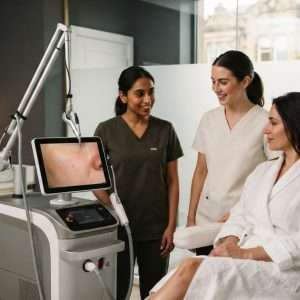
Hair removal methods have evolved significantly, offering a range of options from temporary surface treatments to more advanced, long term solutions. Understanding the differences between these approaches is important when selecting a treatment that aligns with both expectations and skin health.
Laser hair removal is often compared with Intense Pulsed Light and traditional methods such as waxing and shaving. While each has its place, the level of precision, consistency, and long-term reduction varies considerably.
At Arden Clinic, treatment recommendations are guided by clinical assessment rather than convenience, ensuring each approach is considered in the context of effectiveness, safety, and outcomes.
Hair Removal Methods In Clinical Practice
Hair removal methods can be broadly divided into two categories.
Surface level methods include shaving, depilatory creams, and waxing. These remove visible hair but do not affect the follicle’s ability to regenerate, meaning regrowth is continuous.
Light based treatments, such as laser and IPL, work at the follicular level. These aim to reduce the follicle’s ability to produce hair over time, offering longer-lasting results when delivered as part of a structured course.
This distinction is central to understanding the differences in outcomes among the available options.
Laser Hair Removal Technology
Laser hair removal uses a focused beam of light at a specific wavelength to target melanin within the hair follicle. The energy is absorbed and converted into heat, disrupting the follicle and reducing its ability to regenerate hair.
Because the wavelength is controlled and consistent, energy can be delivered with precision. This allows practitioners to target the follicle effectively while protecting surrounding tissue.
Treatment is carried out in line with the natural hair growth cycle, enabling progressive reduction over multiple sessions.
Intense Pulsed Light Technology
Intense Pulsed Light uses a broad spectrum of light rather than a single wavelength. This light is filtered to target pigment but is less specific than laser technology.
Because IPL emits multiple wavelengths simultaneously, the energy is more evenly distributed. This reduces precision and can limit the ability to target the follicle at depth consistently.
IPL is commonly offered in beauty settings and can be effective in certain cases, though results are often more variable.
Precision and Energy Delivery
The key distinction between laser and IPL lies in the way energy is delivered.
Laser systems deliver a focused wavelength that penetrates the skin to a controlled depth, enabling targeted follicle disruption.
IPL devices emit a range of wavelengths simultaneously. Although filters are applied, the energy is less concentrated, which can reduce efficiency and consistency.
This difference directly affects both the results and the treatment’s predictability.
Treatment Depth and Follicle Targeting
Effective hair reduction requires energy to reach the follicle at the correct depth. Laser systems are designed to penetrate the skin in a controlled manner, allowing consistent follicle targeting.
IPL treatments tend to deliver energy more superficially. This can limit effectiveness in areas where hair follicles sit deeper within the skin.
This distinction is particularly relevant to areas such as the back, chest, and hormone-sensitive zones.
Consistency Of Results
Laser hair removal is delivered using calibrated medical devices, supporting consistent energy delivery across sessions. This allows results to build progressively over time.
IPL outcomes can be less predictable due to variation in device quality and energy dispersion. Some clients may experience partial reduction, while others see limited change.
Consistency is an important factor in achieving long-term reduction.
Suitability Across Skin Tones
Skin tone plays an important role in treatment selection. Modern laser systems can be adjusted to suit a wide range of skin tones when used correctly.
Controlled energy delivery allows effective follicle targeting while protecting surrounding skin. This makes laser hair removal a suitable option for a broader range of clients.
IPL treatments can require more cautious settings due to less precise energy delivery, which may reduce effectiveness in some cases.
Comfort and Skin Response
Advances in laser technology have significantly improved treatment comfort. Gradual energy delivery and integrated cooling systems enable treatments to be performed with minimal discomfort for most clients.
IPL treatments vary depending on the device and settings used. Some systems deliver sharper pulses, which may feel less comfortable.
Temporary redness or warmth can occur with both methods, though controlled laser delivery supports a more predictable skin response.
Treatment Efficiency and Time Investment
Laser hair removal is designed to achieve progressive reduction over a defined course of treatments. With consistent intervals, visible improvement is often seen within the early stages of treatment.
IPL may require more sessions to achieve comparable outcomes, and results can vary.
When considering maintenance, laser hair removal often provides greater efficiency.
Laser Hair Removal Compared With Traditional Methods
Shaving, waxing, and depilatory creams remain widely used due to accessibility. However, these methods do not affect the follicle and require repeated application.
Shaving removes hair at the surface and often leads to rapid regrowth. Waxing removes hair from the root but does not reduce the follicle’s ability to produce new hair.
Laser hair removal addresses the underlying follicle, supporting reduction and smoother skin.
Comparison Of Treatment Methods
| Treatment Method | Technology Or Approach | Follicle Targeting | Result Duration | Skin Considerations | Best Suited For |
|---|---|---|---|---|---|
| Laser Hair Removal | Focused laser wavelength delivered into the follicle | Directly targets melanin to reduce future growth | Long term reduction following a treatment course | Suitable for a wide range of skin tones with professional assessment | Clients seeking long term results and reduced maintenance |
| IPL | Broad spectrum light filtered to target pigment | Less precise targeting due to dispersed energy | Variable reduction, often requiring more sessions | May require cautious settings depending on skin tone | Clients suitable for light based treatment with flexible expectations |
| Waxing | Manual removal of hair from the root | No impact on follicle regeneration | Short term smoothness lasting several weeks | May cause irritation or ingrown hairs | Clients seeking temporary hair removal |
Home IPL Devices and Professional Treatment
At home, IPL devices have become more widely available, offering convenience for personal use. These devices operate at significantly lower energy levels to ensure safety without professional supervision.
As a result, outcomes are typically more gradual and less pronounced compared with clinic-based treatments. Professional laser systems enable controlled energy delivery tailored to individual skin and hair characteristics, supporting more consistent results.
Ingrown Hairs and Skin Texture
Laser hair removal offers benefits beyond hair reduction. Reducing follicle activity can help minimise ingrown hairs, irritation, and uneven skin texture caused by repeated shaving or waxing.
This is particularly beneficial for areas prone to sensitivity, such as the bikini line, underarms, and beard area.
Cost Over Time
While surface level methods may appear more affordable initially, they require ongoing repetition. Over time, the cumulative cost of waxing or repeated treatments can become significant.
Laser hair removal is structured as a course of treatments, followed by occasional maintenance. When viewed over the long term, this approach often provides greater value alongside improved results.
Realistic Treatment Outcomes
Laser hair removal provides long-term reduction rather than complete permanent removal. Over time, hair becomes finer, lighter, and less dense.
Maintenance sessions may be required, particularly in areas influenced by hormonal factors. Individual response varies depending on hair type, skin tone, and adherence to the treatment plan.
Clinical Expertise and Treatment Quality
The effectiveness of any light-based treatment depends not only on the device but also on the practitioner’s expertise. Correct assessment, appropriate settings, and ongoing evaluation are essential for achieving consistent outcomes.
Inconsistent or poorly calibrated treatments are a common cause of suboptimal results. A clinically guided approach supports both safety and effectiveness.
Personalised Laser Hair Removal At Arden Clinic
Laser hair removal at Arden is delivered through a personalised and clinically informed process. Skin tone, hair characteristics, and growth patterns are assessed in detail before treatment begins.
Advanced technology enables precise energy delivery, while practitioner expertise ensures treatments are adapted as progress is made.
Further guidance on treatment timing can be found in our article on hair growth and laser treatment cycles, and detailed information on treatment areas is available on our laser hair removal treatment page.
A consultation allows for a tailored treatment plan based on your individual needs.
Confidence In Treatment Choice
Selecting the right hair removal method involves balancing convenience, effectiveness, and outcomes. Laser hair removal offers a structured, clinically supported approach that targets the follicle rather than the surface.
With appropriate technology and practitioner expertise, body treatments can be delivered safely and consistently, supporting results and improved skin comfort.
Related Articles
- Laser Hair Removal and Skin Tone Considerations
- Professional Laser Hair Removal In Bradford
- Your Hair Growth and Laser Treatment Cycles
- Lasting Hair Reduction and Skin Health
- Why Laser Hair Removal Is the Best Decision You’ll Make This Year
Prefer an AI Summary?