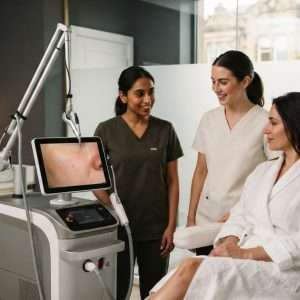
Could laser hair removal work through movement rather than a series of separate flashes? If terms such as SHR and wavelength make the technology difficult to picture, that’s understandable. Understanding how Soprano Titanium laser works starts with its three wavelengths: Alexandrite 755 nm, SPEED 810 nm and Nd:YAG 1064 nm. The system combines these wavelengths to provide different options for delivering energy towards hair follicles.
Treatment also uses SHR technology and an In-Motion technique, with the applicator moved across the area as energy is delivered. ICE Plus cooling helps cool the skin’s surface during treatment, which may support comfort, although experiences vary. These features explain how the system is designed to work, but they don’t determine whether it’s suitable for you or what results to expect.
This article explains the wavelengths, moving delivery and cooling in plain English, and outlines why individual assessment matters. At Arden Clinic, treatment planning is based on your needs and a professional assessment, so you can discuss suitability and expectations before deciding whether to proceed.
Key Takeaways
- Understand how Soprano Titanium laser works, using laser energy to target hair follicles as part of hair reduction treatment.
- Learn what the Alexandrite 755 nm, SPEED 810 nm and Nd:YAG 1064 nm wavelengths, SHR technology and ICE Plus cooling contribute.
- Find out why suitability depends on your hair and skin characteristics, treatment area and goals. Laser can treat PCOS-related hair, but it doesn’t cure PCOS.
- Explore next steps with Arden Clinic in Bradford or Leeds. If you’re travelling from Halifax, Keighley or Dewsbury, ask which location is suitable for your enquiry.
How does Soprano Titanium laser hair removal work?
Laser hair removal uses light energy to target pigment in the hair. The pigment absorbs the energy and converts it into heat, which is intended to affect the hair follicle and reduce its ability to produce hair. The aim is gradual hair reduction, not a guaranteed outcome for every person.
What happens to the hair follicle during treatment?
Hair grows in cycles, and hairs are not all in the same phase at the same time. Laser treatment is generally most effective on hairs in an active growth phase, so one appointment won’t target every hair equally. A course of treatments is often planned around the individual and treatment area. The number of sessions and the response vary.
What Soprano Titanium means in this context
At Arden Clinic, Soprano Titanium refers to genuine Alma Lasers technology used for laser hair removal. The system combines Alexandrite 755 nm, SPEED 810 nm and Nd:YAG 1064 nm wavelengths. Nd:YAG is a type of laser technology; you can read more about Nd:YAG laser technology. The system also uses SHR technology, the In-Motion technique and ICE Plus cooling. These features describe how the device delivers treatment, but the name alone can’t predict an individual result.
In plain terms, how Soprano Titanium laser works depends on laser energy interacting with hair pigment, alongside an approach tailored to the person. Hair and skin characteristics, the area being treated and individual response all matter. A professional assessment helps determine whether treatment may be suitable and how it should be planned. Learn more about laser hair removal at Arden Clinic.
How Soprano Titanium’s wavelengths and technologies work
Soprano Titanium combines three wavelengths with SHR technology, the In-Motion technique and ICE Plus cooling. A wavelength describes the distance between light waves. It is measured in nanometres (nm), so the numbers indicate different properties of the light, not a treatment setting or a promise about results.
How should readers understand 755 nm, 810 nm and 1064 nm?
Arden Clinic’s Soprano Titanium uses Alexandrite 755 nm, SPEED 810 nm and Nd:YAG 1064 nm. The system combines these wavelengths to provide different laser options for treatment. Their precise use should be considered as part of an individual assessment. The figures alone don’t show which option is suitable for a particular person or skin tone.
For context, the US FDA document describes the phrase FDA-cleared for permanent hair reduction. This is regulatory wording about hair reduction, not a promise of permanent removal or an assurance of an individual outcome. It also doesn’t replace an assessment of suitability for treatment in the UK.
What are SHR, In-Motion and ICE Plus?
SHR, or Super Hair Removal, is the system’s approach to delivering repeated pulses as the applicator moves across the treatment area. The In-Motion technique refers to this moving delivery, rather than treating the area only with separate, stationary placements. The approach is designed to build energy gradually in the targeted area. Sensation and response can vary between individuals.
ICE Plus is the system’s contact-cooling technology. It cools the skin’s surface during treatment, but that doesn’t mean the experience will be pain-free for everyone. Comfort can differ between people and treatment areas.
These features help explain how Soprano Titanium laser works, but they don’t determine whether it’s right for you. If you’re considering treatment, you can contact Arden Clinic to discuss an assessment.
Who may be suitable for Soprano Titanium, and what affects treatment?
Suitability depends on your hair and skin characteristics, the area you’d like treated and your goals. The device name alone can’t determine whether laser hair removal is appropriate for you. At Arden Clinic, an assessment helps the practitioner consider these factors and discuss a plan suited to your circumstances.
Why does individual assessment matter?
An assessment is an opportunity to discuss relevant health and treatment history, the area of concern and what you hope to achieve. It also allows the practitioner to consider whether the technology and proposed approach are suitable, and to explain possible limitations. No single treatment plan is right for everyone.
Laser hair removal can treat unwanted hair associated with PCOS, but it doesn’t treat or cure PCOS itself. If you have questions about the condition or changes in hair growth, discuss them with an appropriate healthcare professional as well as raising them during your treatment assessment.
What should someone ask before starting?
Ask which technology will be used and why it may suit your needs. It’s also sensible to discuss the likely course of treatment, how appointments may be planned, aftercare and factors that could affect results. Multiple sessions are often needed, but there’s no fixed number that applies to everyone. Results vary according to individual characteristics and response.
For more background, read the clinic’s laser hair removal guide, then review the laser hair removal service for treatment information. Use an assessment to clarify your suitability and expectations before deciding whether to proceed.

How to explore Soprano Titanium treatment with Arden Clinic in Bradford or Leeds
If you’re considering treatment, start by identifying the area you’d like treated and what you hope to achieve. Arden Clinic offers Soprano Titanium laser hair removal in Bradford and Leeds, with treatment planning based on individual assessment. If you’re in Halifax, Keighley or Dewsbury, contact the clinic to ask which location is relevant to your enquiry.
What can a consultation help clarify?
A consultation gives you time to discuss your treatment goals, relevant history and questions about how Soprano Titanium laser works. The practitioner can consider your hair and skin characteristics and treatment area, explain whether the approach may be suitable, and talk through realistic expectations. You can also ask about the technology, possible sensations, aftercare and factors that may affect your response. The discussion helps inform a plan, but doesn’t guarantee a particular result.
Use the conversation to understand the proposed approach before deciding whether to proceed. A practical sequence is:
- Identify the area you want treated and your goals.
- Arrange an assessment at a suitable clinic location.
- Discuss suitability, expectations and any questions you have.
- Review the suggested plan and consider whether it feels right for you.
How to take the next step
Arden Clinic operates in Bradford and Leeds. If you’re travelling from Halifax, Keighley or Dewsbury, ask which location and appointment arrangements are relevant to your enquiry rather than assuming every appointment is available at both clinics. You can get in touch with questions about laser hair removal or to discuss an assessment. There’s no need to decide on treatment before you understand the proposed plan and its limitations.
Take the next step with a clear treatment plan
Understanding how Soprano Titanium laser works means looking at the combined approach: genuine Alma technology with Alexandrite 755 nm, SPEED 810 nm and Nd:YAG 1064 nm wavelengths, alongside SHR, In-Motion delivery and ICE Plus cooling. These features describe the system, but they can’t guarantee a particular result or sensation.
Suitability and treatment planning depend on your individual hair and skin characteristics, treatment area and goals. Multiple sessions are often needed, and results vary. Arden Clinic takes an assessment-led approach, giving you the opportunity to discuss whether treatment may be appropriate and what to expect before making a decision. This can help whether you’re based in Bradford or Leeds, or are enquiring from Halifax, Keighley or Dewsbury.
A professional conversation can help you make an informed choice at your own pace.
Frequently Asked Questions
What do the three Soprano Titanium wavelengths mean?
They describe the wavelengths of light used by the system, measured in nanometres. The three are Alexandrite 755 nm, SPEED 810 nm and Nd:YAG 1064 nm. These are combined within the Soprano Titanium platform, but the numbers alone don’t determine which approach is suitable for you. A practitioner considers your hair and skin characteristics, treatment area and goals when discussing treatment.
Is Soprano Titanium laser hair removal permanent?
It’s designed to reduce unwanted hair, but permanent hair removal isn’t guaranteed. Hair growth cycles mean that multiple sessions are often needed, and results vary between individuals. Some hair may remain or grow back over time. A consultation can help set realistic expectations based on your circumstances, including the area you want treated and your treatment goals.
Does Soprano Titanium laser hair removal hurt?
Sensation varies from person to person and between treatment areas, so it can’t be described as pain-free for everyone. Soprano Titanium includes ICE Plus cooling, which cools the skin’s surface during treatment, alongside SHR technology and the In-Motion technique. These features don’t guarantee a particular sensation. Discuss any concerns during your assessment so the practitioner can explain what to expect.
Can Soprano Titanium treat PCOS-related unwanted hair?
Laser hair removal can treat PCOS-related unwanted hair, but it doesn’t cure PCOS or address its underlying cause. Hair growth and response to treatment can vary, so an individual assessment is important when considering a plan. Arden Clinic offers Soprano Titanium laser hair removal in Bradford and Leeds. If travelling from Halifax, Keighley or Dewsbury, ask which clinic location is appropriate for your enquiry.